


When Dakotah Rice and Tushar Nair started, it was with the intention of building an AI tool for insurance brokerages. They spent months applying for insurance jobs on Indeed, getting inside brokerages, learning the processes and the problems, before pivoting away from the tool and starting their own brokerage called Harper.
A narrative violation. This was typically the moment where you would build a tool to sell to vendors; not become a vendor yourself. But somehow the latter is exactly what is happening today, giving birth to firms that are part industry experts and part AI, or as they have now been named: neofirms.
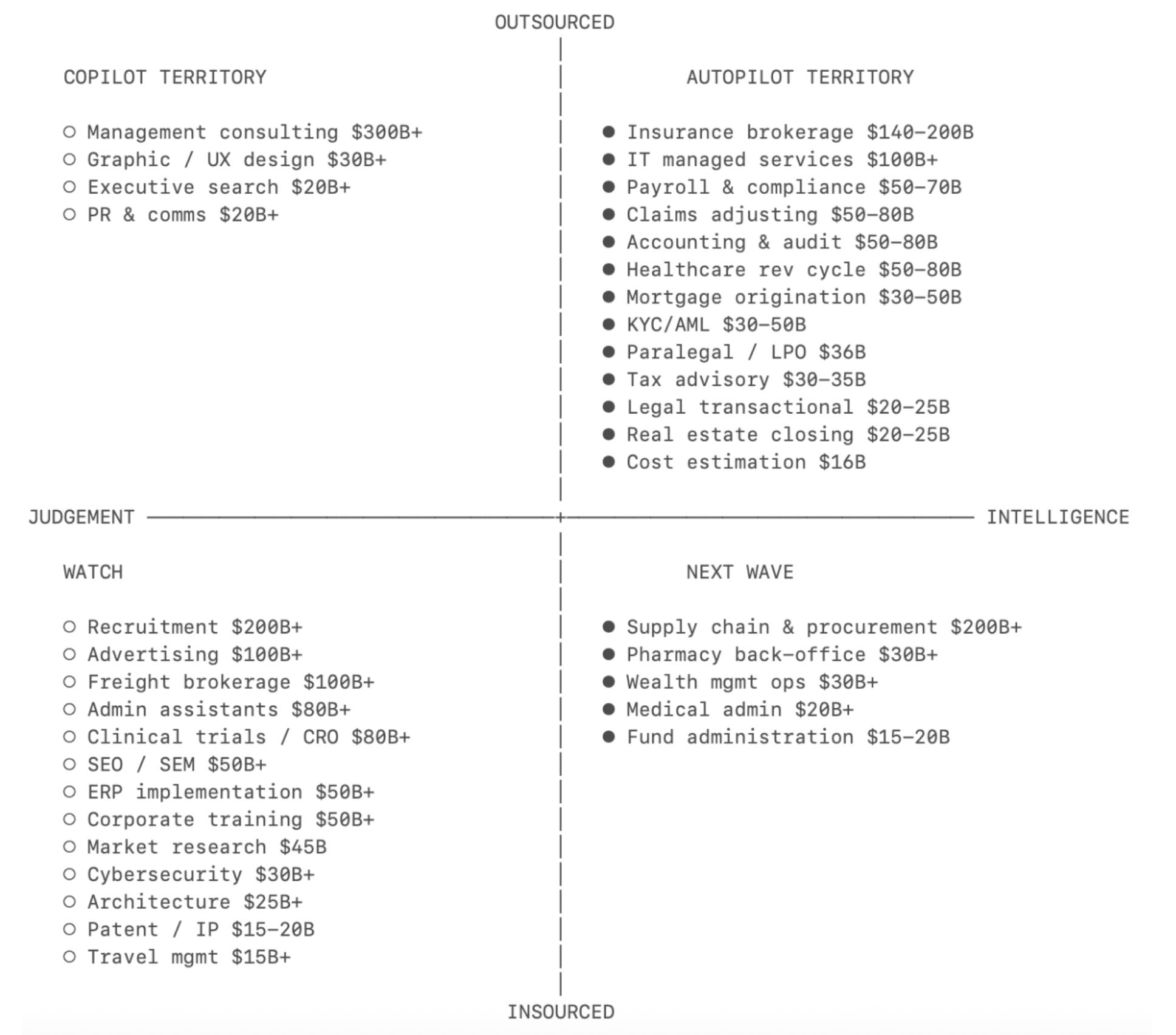
Julien Bek of Sequoia has a thesis for this turning tide. He captured it in his March 2026 essay, Services: The New Software, where he wrote that the next $1T company will be “a software company masquerading as a services firm.”
Implying that it would sell work rather than tools, restructure all kinds of service industries, and do so while breaking away from the poor-margin, high-headcount past of services and the limited-TAM, limited-agency past of SaaS.
He also argued that this is one of the better, fortified ways to build today, while ensuring you don’t become a casualty in the next vertical expansion maneuver from the big labs: “If you sell the tool, you’re in a race against the model. But if you sell the work, every improvement in the model makes your service faster, cheaper, and harder to compete with.”
Crosby is another such neofirm, in legal. And so is Quanta, in accounting. But that’s not all, the recent cohorts of YC alone feature startups building neofirms for something as broad as finance audits to something as niche as government affairs.
While the theses abound, there isn’t a synthesis of the founders’ thinking and hunches, hard-won and tested in practice. In this edition we will collate one, surfacing useful patterns and mechanics, and end with one big open question.
To ground these explorations, we will refer to Crosby, Quanta, and Harper, 3 neofirms with great ambitions and traction. We will also take notes from Emergence Capital’s incredibly insightful playbook on the matter along with other VC theses such as Bessemer, Foundation Capital, and of course Sequoia.
P.S. Even if you aren’t building a neofirm, there’s a lot to be learnt here because the central expectation from all enterprise software is increasingly shifting towards delivering end-to-end work.
Table of contents:
Work spend : tool spend — the gap and the opportunity
Zeroing-in on an industry
Finding a wedge
Ways neofirms need to operate differently
Proving your PMF
Where’s the defensibility?
Will this work?
#1: Work spend : tool spend — the gap and the opportunity
The central premise underlining the services thesis is that AI lets you sell work into a much larger TAM, given it now includes the TAM of labour and services. Julien illustrated this using the 1:6 ratio in his essay — stating that organizations spend $6 on services for every $1 on tools.
In the categories we are looking at, the gap is even more extreme.
Legal:
US legal tech spend sits in the $7–8B range on the narrower end, most of it going to Westlaw, Lexis, Relativity, and Clio. Crosby’s co-founder, Ryan Daniels, puts US legal services at roughly $400 billion. So, per back-of-the-napkin math, about $1 of software for every $50 of legal work. Ryan’s estimate of the legal tech market is higher, closer to $20B, which would still leave a 1:20 gap.
Accounting:
US accounting software spend was around $6.4B in 2025, most of it on QuickBooks, Xero, NetSuite, and Sage Intacct. US accounting services the same year was roughly $164B. So, about $1 of software for every $25 of accounting work.
Insurance brokerage:
US agency management software was around $1.7B in 2025, split mostly between Vertafore, Applied Systems, and EZLynx. US brokerage revenue the same year was $261.7B. About $1 of software for every $150 of brokered work.
In practice, all 3 of these industries beat the 1:6 tool:work estimate.
A fair question that needs addressing before we go any further is why wouldn’t the traditional services disrupt themselves?
Ryan has a theory: “When you build a really great labour and services business that’s working, there’s not a lot of incentive to innovate and disrupt yourself, especially when your margins are pretty thin.”
That said, Kirkland & Ellis, the largest law firm in the world by revenue, is already spending $500mn building its own AI technology but there are no public wins yet.
As far as these upstarts and their new model is concerned, early demand signals seem encouraging. Today:
Crosby has a hundred+ clients including Cursor, Ramp, and Clay, and has reviewed about 13,000 contracts; where a single, unassisted NDA review takes 58 mins, Crosby claims to do it in 4 min 53 sec. Their revenue is up ~400% since October, with $85.8 million raised.
Quanta has hundreds of customers, with annual contracts of $15,000 to $25,000, and their close time is under a day against the industry standard of four to eight weeks. They have raised $20 million so far.
Harper has six to seven thousand customers, is past $5 million in ARR with 32 employees and $46.8 million raised. While a traditional broker takes weeks for a complex insurance, Harper does it in 24-48 hrs.
#2: Zeroing-in on an industry
Start with a list of service industries and you’ll drown; all of them are large, most are badly served, and they have a way of looking close to identical on paper. That’s not how the founders of Crosby, Quanta, and Harper made their respective picks.
Instead, each of them started with a space they could already get inside, and then went and looked at the work being done by hand. Crosby’s Ryan Daniels has a name for it: Genchi Genbutsu. From the Toyota production system, meaning ‘go see for yourself’ as documented in this brilliant New Ontologies profile.

Across his story and others, a heuristic for zeroing-in emerges:
1. Leverage your proximity and credibility:
Services run on trust, and a neofirm is no different. Given that, the founding team’s background can be especially critical.
Emergence Capital puts it succinctly: “In traditional SaaS, you’re selling a product. In AI-native services, you’re selling yourself. Domain credibility isn’t just important; it’s existential.”
Ryan trained as a lawyer at Stanford, practiced at Cooley then went in-house as the only legal person at a startup growing from 10 to 100 people, he had the credentials. Further, as someone who spent most of his time on contracts and MSAs, he knew the pains, the processes, and the bottlenecks incredibly well.
Quanta’s founder, Helen Hastings, too, was able to find early leads for research and demos because of warm introductions. She says that her experience at Affirm was why people said yes.
"Legal services, I think economists call it a credence good, which means that you only know how good it is after you’ve experienced it and consumed it, and you need an expert to actually tell you the quality. A lay person, or even not a lay person — a sophisticated CEO — often doesn’t know, by definition, how good their legal work is.” — Ryan on why trust is paramount in services.
A lack of credibility and proximity can be fixed, though. Jake Saper from Emergence adds two conditions that break this constraint: the founders go as deep as humanly possible on the service, and/or they hire senior domain experts (with credibility and network).
2. Go where the demand is overwhelming:
Dakotah and Tushar didn’t have an insurance background per se, but Dakotah’s childhood gave him exposure to insurance because of his family business. The domain fell on his radar per chance.
What made him commit to it was a strong signal of unfulfilled demand. During research, they had applied to hundreds of insurance sales jobs on Indeed and heard back within 10 minutes. They saw that there was a dearth of people who could sell insurances; all while many small and medium businesses were retiring.
#3: Finding a wedge
Much like software, once you have picked an industry, you’ll need a wedge to get inside — that or you’ll be boiling the ocean.
Here are the markers of a strong wedge in services:
1. Start with what is outsourced:
Julien’s base characteristic of a good wedge in services is outsourced work:
“If a task is already outsourced, it tells you three things. One, the company has accepted that this work can be done externally. Two, there’s an existing budget line that can be substituted cleanly. Three, the buyer is already purchasing an outcome. Replacing an outsourcing contract with an AI-native services provider is a vendor swap. Replacing headcount is a reorg.”
It is indisputable that the TAM for an autopilot is all of the labour spend in a category, but the easiest place to start is where outsourcing already exists. This, then, isn’t a weakening of the ambition, but a strategic entry point. Julien urges founders to think of the outsourced task as the wedge, and the insourced work as the long-term TAM.
And it checks out with the approaches of the three startups we are focusing on. Contract review sat with outside counsel, bookkeeping sat with an outsourced firm or offshore team, and commercial insurance was always brokered.
Helen distills the why: “The service already existed and customers already disliked it, so there was no category to create and no user education to fund.”.
Go in. Rip and replace.
2. Pick work that is more intelligence-heavy than judgement-heavy:
Julien’s second criterion is to pick work that’s more intelligence-heavy than judgement-heavy, where intelligence refers to work with defined rules. Ryan also felt this in legal: “An enormous amount of legal work is formulaic, because contracts are full of if-then conditional statements.”
Ryan and Dakotah share two other interesting details to notice:
Slightly too complex for AI alone. Ryan says that AI is already good at NDAs and offer letters, which is why they aren’t a wedge anymore. Master Services Agreements (MSAs) at 12 or 13 pages is. An NDA is usually one negotiated term, but an MSA is a full commercial relationship with details like payment terms, liability caps, IP, data handling, etc. It’s complex enough that AI alone gets it wrong, and simple enough in structure that AI plus a lawyer is genuinely faster than a lawyer alone.
Look beyond the commoditized level of service. Dakotah quickly ruled out commoditized insurance where people just wanted the cheapest price and no intermediation was needed. What he wanted was regulation that forced an intermediary, and low standardization to warrant a service.
“There’s a lot of things that happen in insurance that result in a $10,000 payday for revenue that may have 50 steps. If you’re able to reduce 50 steps to five steps, times all of the customers that you have in that type of revenue, you can build a business that’s a massive revenue business with a crazy margin.” — Dakotah Rice, Harper

3. Judgment does not disappear, it moves above the abstraction
“Most lawyers would just say it’s impossible [to automate legal work]. Most technologists would say this is all automatable. And the truth is somewhere in between.” — Ryan Daniels, Crosby
If you go looking for a purely intelligence-shaped wedge, you may not find one.
Dakotah is of the opinion that it is impossible to disconnect judgement and intelligence entirely. Knowing this, at Harper, agents handle collection and the back-and-forth, and human judgment concentrates at the point of actually selling the policy.
Ryan also shares that there’s a paint-by-numbers element to law that is hard to even identify. He describes the difficulty of taking a hundred-step workflow and working out that steps 17 to 30 can be automated while 36 to 41 can’t.
Given this, the more grounded question on wedges isn’t what is purely intelligence but where in the workflow the judgment still remains difficult to codify. If it sits at the end, near the close, you can automate the long middle and keep a human on the last mile. (We will get into the team structure needed to enable this below.)
#4: How neofirms operate differently
A neofirm has quirks of its own. Some tensions that resemble how services get sold and built, some that exert pressures on software’s way of roadmapping and operating, and some that are entirely unique to it; here are a few, emerging mechanics:
1. Take the liability seriously
“We have malpractice insurance. We take liability for all the work we do. I don’t think we exist as a business if we don’t do that.” — Ryan Daniels, Crosby
Some say that in addition to the service, organizations pay for “a throat to choke”. Underneath that universally deployed, nonetheless disturbing analogy is a simpler truth: if you sell a service, you also have to take on liability, often of a magnitude that’s directly proportional to the criticality of your service.
Crosby knew legal is high stakes, so they went and incorporated a law firm, employing barred attorneys and carrying its own malpractice insurance from the beginning.
Harper had to comply because brokerage is licensed state by state. Quanta made a different call, offering back-office bookkeeping and controller work while stopping short of anything requiring a public accountancy license.
2. Own the implementation and the outcome
“In SaaS, a customer buys your product and implements it. In AINS, you ARE the implementation. Delivery isn’t a support function; it’s the core of what you sell.” — Emergence Capital
This dramatically changes what “good enough” means. A SaaS company can ship an excellent product and deliver a mediocre implementation, and the customer will mostly blame themselves.
A neofirm can’t.
Harper, Crosby, and Quanta treat daily delivery as their primary engineering signal. And structure teams in ways that allow for that signal to reach the people writing code, fast. Crosby seats lawyers next to engineers, offset one by one, where evals land every few hours.
This emphasis on delivery makes the case for features that might otherwise seem unnecessary, but give users the controls that they need to feel confident in a new way of doing things. For instance, Braintrust’s (a Crosby customer) Chief of Staff, named cross-checking features, internal notes, and ETA metrics as what earned the migration, as shared here.
Most of these orgs also have specialized agents and processes for delivery.
Crosby has an internal paralegal agent that quickly routes every query to the best available lawyer so a customer doesn’t have to wait.
Harper’s equivalent is matching — a system that synthesizes across its entire network of wholesalers, MGAs, and carriers at once, weighing appetite and pricing patterns in a way no single broker’s personal relationships could match, so a business doesn’t wait on one person’s memory.
3. The roadmap tradeoff
“If a customer has a new feature request, we can’t say I got it on the roadmap for 6 months from now. If we hit an edge case, what should be a new feature, we are on the hook to handle it because we committed to doing all of the accounting.” — Helen Hastings, Quanta, at Beelieve’26
That’s what being an AI-enabled service is — you are on the hook for getting things done, and a second-order effect of being-on-the-hook is a new kind of pressure on your roadmap.

Every neofirm user comes in with custom requests, cumulatively it can pull you into all directions, without giving you a chance to say no. There are two reasons for this: 1) you promised the outcome, 2) the edge cases help you build coverage.
That considered, Ryan has a number for when you can start being more mindful:
“As a rule of thumb, we started to see patterns when we got to about 80 clients. Before that, we didn’t know what client preferences were rules or exceptions. That’s when we felt comfortable starting to say no to customer requests.”
4. A genuinely new team composition
Crosby’s early team can be split into 3 kinds:
SMEs: lawyers and domain experts;
builders: researchers and engineers;
amplifiers: operationally minded technical people.
The third group is especially interesting.
Crosby’s ops team came partly from Scale — people with CS backgrounds who were not necessarily engineers. They would watch lawyers take 6 clicks where 1 would do, then ship or spec a quick fix.
Ryan calls this out as one of the things he wishes he had known earlier: ”For tech-enabled services businesses, having a cracked hit squad that’s technical but really operationally minded changes everything”, he adds.
This resembles neither a standard SaaS org structure nor services.
Emergence also shares two notes on the customer-facing team: “Industry experience is especially helpful in customer-facing team members; so much of this is about trust. You want the buyer to recognize the places your team has worked, ideally trusted brands from legacy service providers.”
They then specify that it is important to include someone who has a deep understanding of the service right in your sales process. This stops you from making false promises or committing to poor, unachievable timelines, which can impact trust.
5. A new kind of pricing model, following the work
AI has brought forth a new pricing philosophy that attempts at tying work, as closely as possible, to the price you pay — per outcome, per credit, per unit of work, etc. The neofirms are particularly well-suited for this evolution.
Emergence’s guidance is that discrete, well-bounded work should be priced per piece of work, while continuous, variable work suits a credits model.
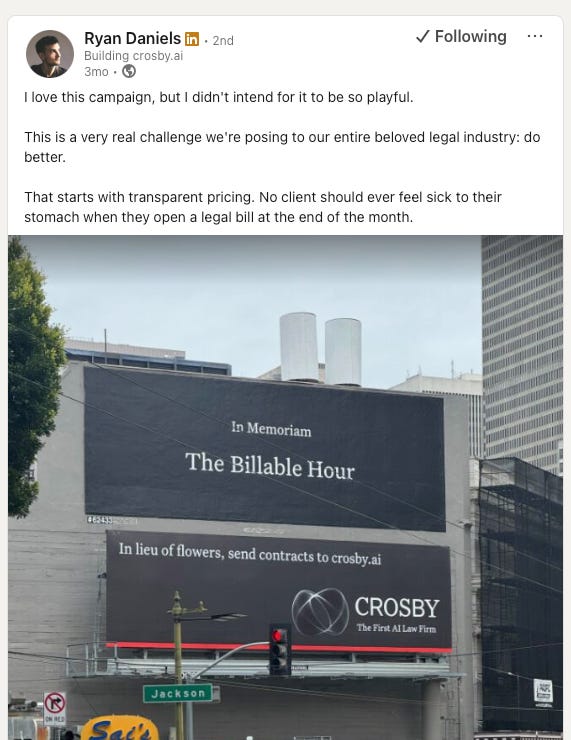
Crosby charges per document, with Forbes reporting prices from roughly $250 to $1,000 per contract, depending on length. Ryan says that killing the billable hour was an intentional, early decision they made. They knew they might risk being margin-negative on some work and took it anyway, because the incentive to find a more productive way to work would then run through the whole company.
Harper follows the brokerage model, where revenue generally comes through carrier commissions rather than a separate SaaS-style fee. That means the customer’s buying motion does not change much, they still pay for insurance coverage, while Harper earns like a brokerage.
Quanta appears to price more like an accounting service than a SaaS product. Public pricing is not clearly listed, and Helen is candid that they are still working it out. Her current position is to price roughly in line with service incumbents and be the obvious choice on a side-by-side comparison.
Emergence thinks that most neofirms might need to start with the market norm.
Bessemer suggests anchoring to the legacy provider and undercutting it, which Ryan disagrees with, saying that undercutting might be read as low quality.
Helen also shares a challenge you might face with a neofirm’s work-based pricing: “People say, well with your competitors I’m paying for a team of humans, and for you I’m not. So why should you be charging me more?”
The honest advice is to use these as references and work out your market and your customers while expecting to land on something that is entirely different.
#5: Proving your PMF
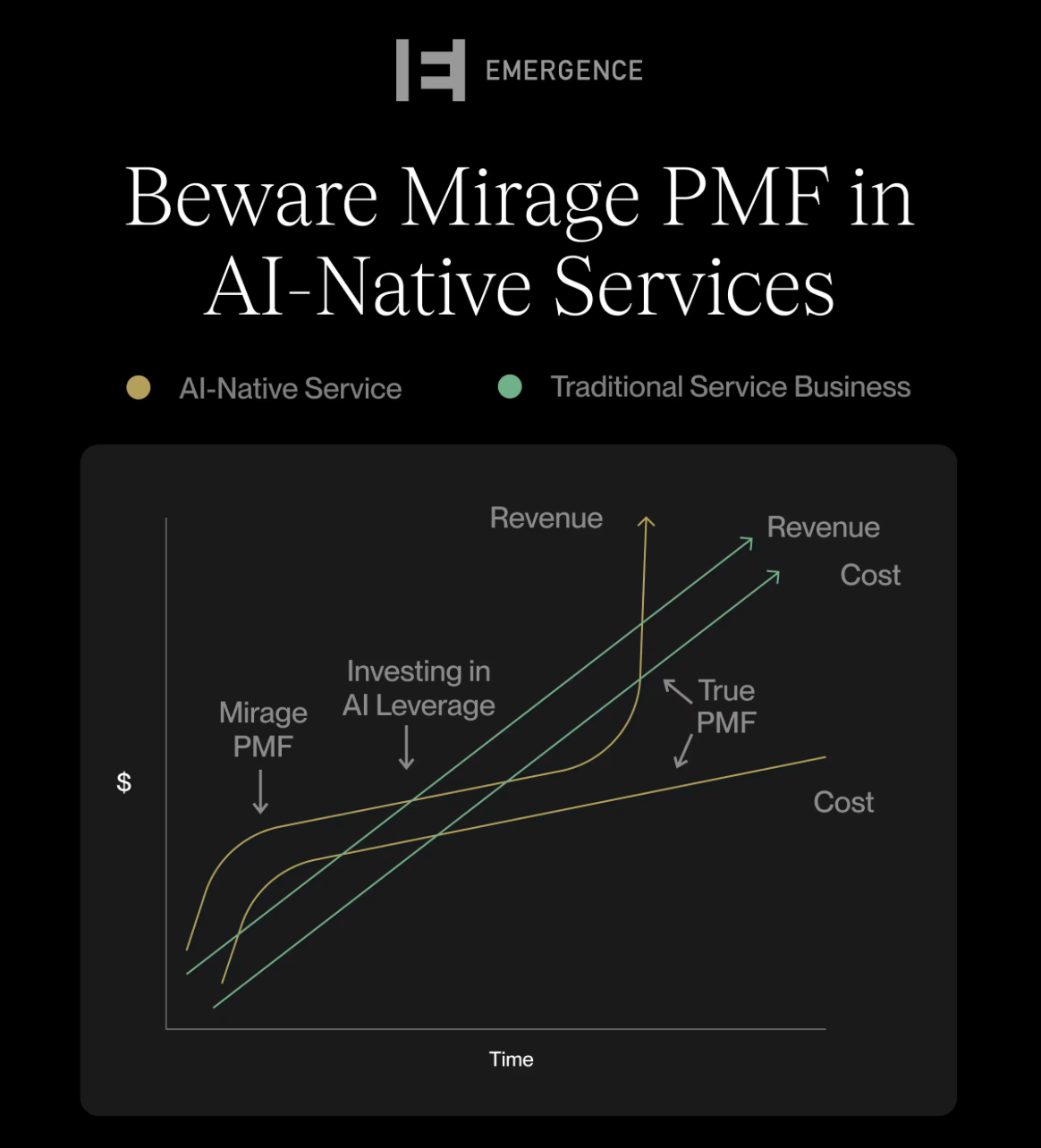
“Real PMF requires proving you can scale non-linearly relative to your costs. To get there, your AI must drive measurable improvements in cost, quality, or speed, or ideally, all three.” — Emergence Capital
A given with software PMF that now applies to services.
Every neofirm has its own north-stars that it treats as leading indicators for PMF. From what we saw, three kinds surfaced: a service metric, an engineering metric, and a quality metric.
Crosby has two service metrics. First is TAT (Total Turnaround Time), measured from the moment a contract lands in the inbox to the moment it leaves, across every round of a negotiation.
The second metric is HURT or Human Review Time, tracked from the moment a lawyer opens a document to the moment they close it. Ryan believes that as HURT approaches zero, their margins will approach software margins.
Harper uses Turnaround Days, against a status quo where a customer spends a month calling broker after broker. Quanta’s is Close Time, against books arriving four to eight weeks late.
Under the engineering metrics, Tushar from Harper shared two that he looks at: throughput and reasoning. Throughput is a bottleneck hunt — whatever currently limits how many deals move through the system. Reasoning is capability, where the same throughput system handles progressively more complicated deals as reasoning models commoditize.
Quality is the third and the hardest to measure. Ryan says there’s a line of academic thinking going back decades that legal quality is simply unmeasurable: “Why do you pay that lawyer $2,000 an hour instead of that lawyer $1,000 an hour? Is he really two times better? It’s probably impossible to explain why.”
John Sarihan, co-founder and CTO, Crosby shares why quality matters so much: “One of the dangerous traps of language models today is they get to 90% for basically free... getting them to 99 or 99.99 is actually extremely difficult.” and that last mile improvement in the quality is what you get paid for.
Then there are more traditional metrics that matter from a purely business POV:
Revenue per employee, ideally meaningfully above legacy providers.
Per-customer margin breakdown, essential for identifying customers that are on a path to AI leverage vs those stuck in labor-intensive delivery.
Gross margin with honest COGS; inference, API spend, and human-in-the-loop labour all inside it.
“You only truly have it when AI is doing a material share of the work at a high gross margin and delivering superior customer outcomes. Otherwise, you’ve built a good services firm financed with the wrong kind of capital.” — Emergence Capital
#6: Where’s the defensibility?
With the number of moving parts in AI, defensibility for anyone, including AI-native neofirms is an open question. Fortunately, we’re seeing some strong ones emerge:
1. Become the system of record.
This is one of the strongest structural moats available, and one that Quanta believes in as well, influencing their decision to build their own general ledger rather than sitting on top of QuickBooks or NetSuite.
Crosby, too, has an SoR called Bailiff — a central system that every contract, template, policy, and guideline flows through. What makes it a moat is what it does with volume: Crosby pools anonymized data across its client contracts to predict how a specific counterparty will react to specific terms, so redlining gets more proactive and negotiation rounds shrink as the dataset grows.
Emergence’s framing is that when you’re the infrastructure layer and the service layer at once, switching becomes doubly hard.
2. Build the proprietary data flywheel.
As Sequoia framed it recently, paraphrased, building as a law firm rather than pure software allows access to confidential contract data that foundation models never see, creating a competitive moat through specialized training datasets.
Whatever data is in distribution, the labs will get to. What would remain untouched is the context that’s unique to each client.
Which is why Crosby is bullish on per-customer fine-tuning and evals. Context like which liability cap their GC has conceded three times, which indemnity language the counterparty always strikes, what they actually settled at last quarter — the stuff that a good firm knows and operates atop.
There are a lot of clashing opinions on whether data is a moat at all, primarily re: pure-play software. What’s under-discussed here is a core difference in the nature of the data that a software product gathers vs. what a services/auto-pilot product does. Software is traditionally limited to data on actions and states, not on the quality of work. A neofirm or auto-pilot has access to both.
Note: Make sure your MSA permits you to use service data to improve the service.
#7: The open question
Will neofirms scale like software, or just become better services firms?
The only deduction we can make from the limited data we have so far is that neofirm margins sit below software and above traditional firms.
Bessemer’s vertical AI portfolio averaged roughly 56% gross margin on a 1.6x burn ratio in 2025. The incumbents aren’t measured the same way — so what we could get to was EBITDAC. Public insurance brokers sit at 30–35%, and accounting firms at 20–30%.
“There are types of human labour that you can replace today, but the amount that your clients will pay you may not be more than the inference costs of serving those clients.” — Ryan Daniels, Crosby
The bet, then, is not that services will become software overnight, but that the best services firms will start behaving more like software companies, with higher margins, proprietary data, and non-linear revenue per employee.
Some of these companies might only end up becoming excellent, modern services firms, and that would still be a large outcome. But the more interesting possibility is the one Julien Bek pointed to in his thesis, that:
”The next $1T company will be a software company masquerading as a services firm.”
A services firm to the customer. Software economics underneath.
A big, heartfelt thank you to every source we referenced! And if you made all the way here, thanks for taking the time. All ears if you have any notes/feedback. :))
Great read. thanks for putting this together Astha!
Make sense for us marker but for Indian market, selling tool still makes sense.