


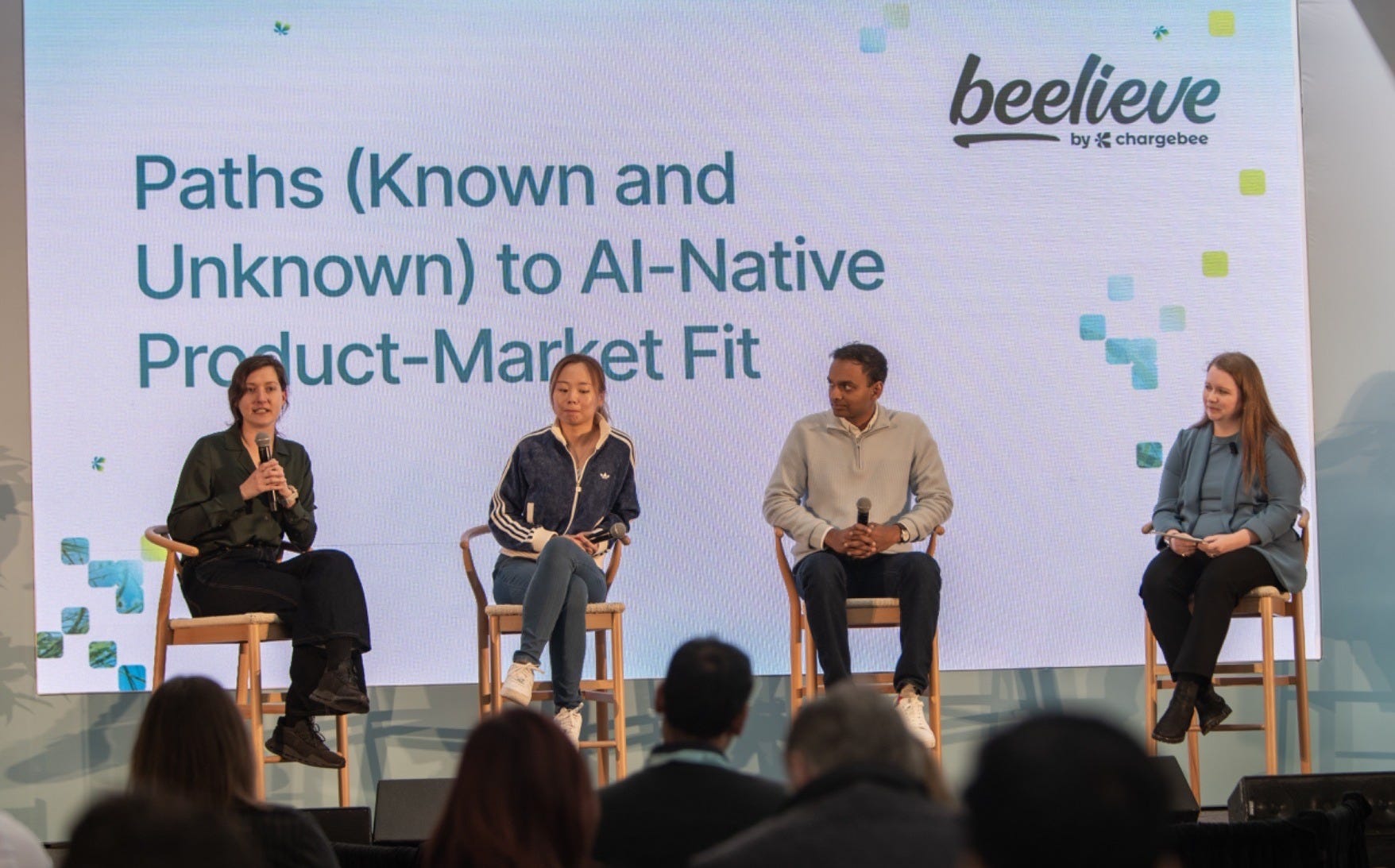
Three years in, there’s no clean answer to the head-scratcher: “What are the paths (known and unknown) to AI-native PMF?”
What margins look like, where value accrues, whether vertical integration still works — while a whole set of critical questions have been made impossibly murkier.
We recently brought together three people (whom you’ve likely heard of) to talk from their own first-hand collisions with this question.
ft. Nikunj Kothari, partner at FPV Ventures and a sharp commentator on the idea maze, GTM, and product who has caught the moment with his prolific Substack,
& Helen Hastings, the founder of Quanta, an accounting services company living out the “Services as Software” thesis,
& and Chun Jiang, CoS at Miro, and an ex-founder who also previously led product at Reforge and helped ship 5 new AI-native launches in a year.
➤ Three threads you should dive in for:
Why wedges are more fraught (as well as more important) than ever before,
how Quanta and Reforge guarded against an unraveling while scaling their PMF,
and why pricing has become doubly critical, and Nikunj’s updated take on why his popular blog “Your ‘Per-Seat’ Margin is My Opportunity”.
Plus some hot takes! ♨️
#1➤ Finding wedges that have an AI future
“In the era of AI, each company and each person is being asked to do more. So either you have to pick a wedge that is extremely deep and you build something end-to-end or if you are picking a horizontal platform, you have to be multi-product from day one.”
Having advised plenty of early-stage founders, Nikunj has seen the wedge question — how you enter a market, and through which door — become increasingly harder to answer. He mentions two traps that he scans for when investing.
“Either the product is so narrow that the market is not large enough and it’s not solving a hard pain point or it is so horizontal that they lose their identity. The best companies are able to go both deep and horizontal at the same time — and that’s extremely challenging, especially when there’s so much competition with every vertical and every space.”
What he’s saying is that if you are too narrow, you can build something genuinely useful but still hit a ceiling at $5M ARR. If you are too horizontal, you can confuse buyers.
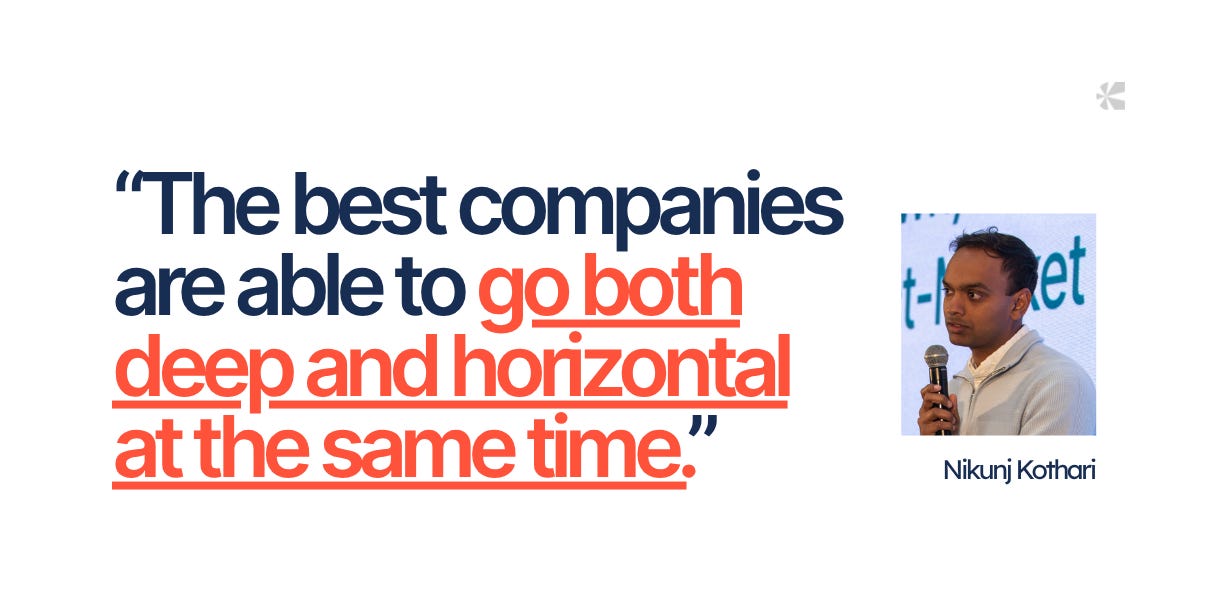
Nikunj calls them traps because they are deceptively fundable in the early rounds, but neither is venture-scale. There’s a simpler, clarifying heuristic he has since developed. He recommends going super deep on the problem but also keeping an eye on the adjacencies you can get into in the next 6 to 18 months.
Helen is building a new kind of company, an AI-enabled services startup for an established problem, which has given her a unique PoV on the question of wedge.
“Our wedge was to start by selling to tiny companies even though I ultimately knew that our main buyer would be at a bigger company.” She thinks of wedges as what needs to be true in the DNA of a company from day one. For Quanta, that DNA-level-necessity was that they needed to do all of the accounting and be the full financial source of truth.
“That was my vision for how we’d actually be able to capture a very, very large market in the long term. But that would be a lot to build, and have a lot of problems if I started by selling to bigger companies. So if I wanted to hold that constant, what are the other dials or variables I can turn? That was company size and stage, and so that’s how we came up with tiny companies as our wedge.”
She could adjust who she was selling to, what industries she prioritized, what geographies she operated in. But the full-service, full-ownership model was non-negotiable, what Helen calls “the natural stepping stone to a very large market.”
Helen is extra cautious of mistaking something for a wedge, especially right now where companies are choosing wedges just because they happen to be making a lot of money now without being able to paint a picture of how they’ll pass some initial milestones to get to a very, very large market.
Chun got to this lesson through a harder path.
Before Reforge, she had built Monterey AI in 2022 as an AI document generator for product teams — using GPT 2.5 to help PMs draft specs, even before ChatGPT existed. The wedge they had picked was “doing one thing really, really well and going to a market we had connections in.”
Once they had users and early revenue, they started looking for the next thing to build to make the product more sticky. That’s how they pivoted to a Voice of Customer platform before exiting to Reforge, taking a lesson along:
“If I would do it again, I’d probably double down on the market or distribution as a wedge instead of really focusing on the product itself. Because when I was selling the document generator, I would just try to sell to the people. But if I had asked more questions about their technical stack, what other pain points were in their workflows — maybe that would have given me even more ideas about where I could expand to.”

#2➤ Building for the $6 TAM
For every $1 spent on software, $6 is spent on services. That’s the market Julien Bek at Sequoia pointed at in March when he argued that the next trillion-dollar company won’t look like a SaaS business — it will look like a services firm.
Helen has been building toward that for years. Quanta doesn’t sell accounting software, it does your accounting. Month-end close, tax filings, all of it. We asked what changes when you’re on the hook for the outcome, not just the tool:
“When you are selling software, you have your one deliverable which is your product roadmap that is shared by all of your customers. When you are a services provider and on the hook for the outcome, you are on the hook for many deliverables. A deliverable per customer that all might look a little bit different and have a different messy reality that maybe you didn’t expect when you first started working with them… We have to close the books at the end of the month no matter what. No matter what weird thing they did that month.”
Helen shares some instances to help visualise: a company might adopt a buggy beta payroll feature from a vendor that creates accounting chaos for Quanta, but Helen and team would still have to do the accounting for it, or a customer’s employee might decide to live in four different states in one month and trigger complex tax implications.
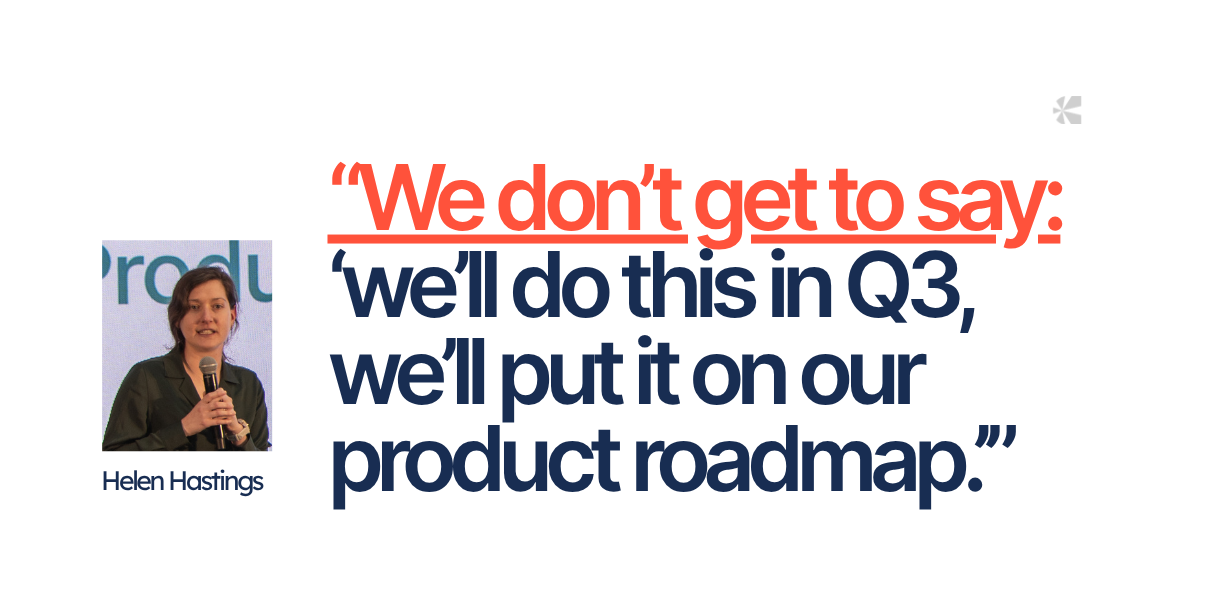
“We’ll need to handle it because it happened that month and we need to close the books that month, we don’t get to say, ‘We’ll do this in Q3, we’ll put it on our product roadmap.’”
Quanta’s model does come with 4 genuine upsides, in Helen’s words:
Quanta is always keeping up with what the market needs because they are forced to.
They get to build with real data, not hypothetical test cases.
They have a forcing function for using AI for what it is good at and handle different kinds of edge cases that would otherwise break traditional software.
The $6 of services for every $1 of software is a big one, of course.
On the cons, Helen says: “We do not have a lot of control over our roadmap and often we have to build things in a hacky way and then come back and build them later.”
#3➤ Humans + ownership = the real AI leverage
Chun noted how a lot of companies go to Reforge wanting to know how the team shipped five AI-native products in a year — especially for a company that didn’t sell software until recently. They assume there’s a secret AI leverage point. There isn’t.
She goes on to talk about the real leverage: people.
“We still attribute that speed to the human foundations that we protect — collapsing the role between engineering, product, and design, pushing engineers to do customer success, pushing PMs to do sales. Once you push people to do these external-facing tasks, they start realizing, ‘Okay, why are we building these features? Is this feature really worth keeping? Should we just kill the whole product?’ As long as you give people enough protection and context and empower them to make decisions, they are the ones that will help you find PMF really fast.”

Finding PMF is only half the problem, though. The moment it works, a different kind of discipline needs to take over, one that Helen has seen and grappled with up-close.
There was a moment in Quanta’s journey that made the reality of selling work visceral: quality is everything and it takes discipline to protect.
Helen’s company was doing incredibly well, bringing on more customers per week than ever, and yet she had to make the decision to stop taking customers.
“We knew that the market wanted the product, they were banging on our door, but we couldn’t reliably handle all the customers that wanted to work with us. And when you have this service layer, it becomes really easy to say yes to a prospect that maybe you can’t fully handle. Once we started bringing on many customers per week, we couldn’t keep up — and we had to take a pause and catch up and build more.”
The obvious pressure-relief valve would have been to hire offshore bookkeepers who were available, affordable, and could handle the volume while engineering caught up. She decided against it. The quality that made Quanta’s early customers stay and refer others was accuracy, consistency, and a level of reliability that made leaders feel like they could trust the numbers
“I did not feel like that was the right decision. It would dilute what made us get product market fit in the first place — our level of quality.”
Helen’s long view on services as software is worth sitting with. The question for AI services companies isn’t whether you can preserve quality as you scale, it’s whether quality can actually compound… something traditional services businesses have never been able to do. And she believes the opportunity is now.
#4➤ The era of “yes, and” pricing models
Nikunj wrote a hot piece almost two years ago titled “Your “Per-Seat” Margin is My Opportunity” arguing that when the primary users of a platform are AI agents rather than humans, per-seat pricing becomes harder to justify and sustain.
He says that it hasn’t happened yet because a lot of buyers are too used to buying software on a per-seat basis. “It’s predictable, your OpenAI bills don’t go up by massive amounts every week or every month, it’s still a transformation, but I think slowly people are getting around to some version of a hybrid scenario.”
Like a “yes, and” thing. “Where you are paying maybe per-seat for humans from the platform perspective but a lot of workflows that run on top of it are being billed as usage or services revenue depending on who is doing it.” he adds, before pointing to the inevitability of the shift.

“Humans are not going to be the primary users of these platforms in the future. How do you price per agent? It doesn’t make any sense. Going back to the $6 to $1 — it’s end-to-end outcomes. What are the outcomes that you’re trying to solve?”
Going back to the inevitability, he points at the classic innovator’s dilemma at play here, insisting that somebody will come bottoms-up, and just do usage-based pricing and it would be far cheaper because they won’t be keeping humans in the center of what they are doing.
#5➤ Hot takes, worth taking seriously
Nikunj shares that he wishes someone had named the technology “amplification intelligence” instead. The word says what AI actually does — it multiplies what’s already there instead of replacing it.
He sees that the bottleneck for most organizations isn’t the technology, it’s the people at the top not using it themselves. The ones who do model a different pace of work, and teams follow.
Chun’s hot take is her emphasizing on two things AI can’t do: building relationships and having fun. She makes a call-back to her feelings about distribution, sharing that your first customers will come from people who trust you and to invest there.
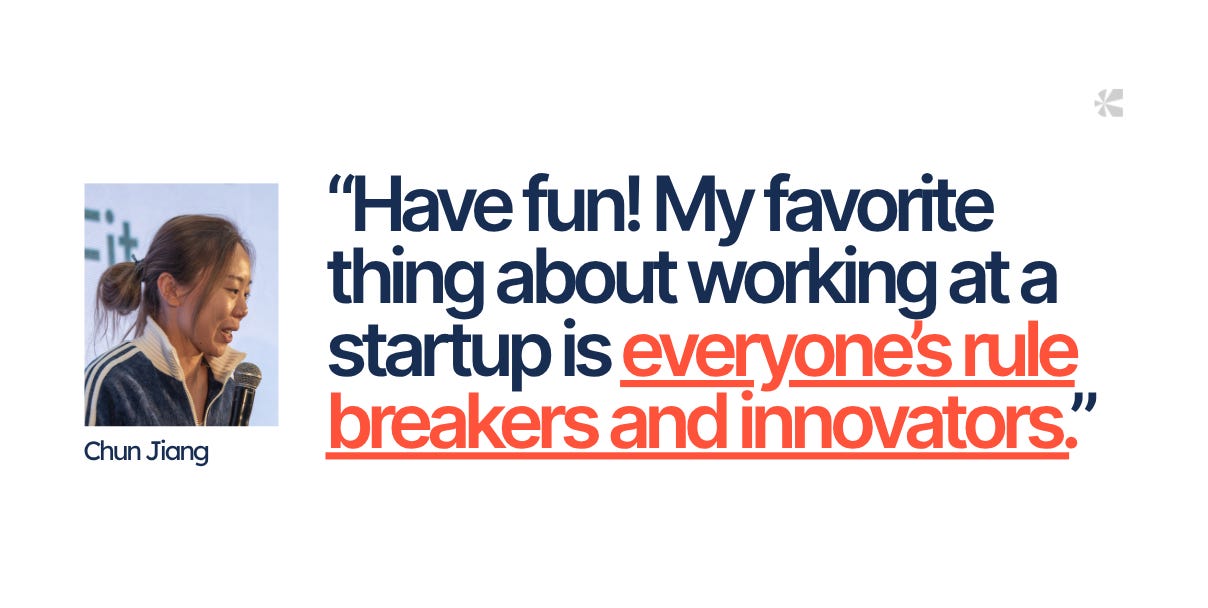
And to have fun, striking a chord with Helen. “Have fun. My favorite thing about working at a startup is everyone’s rule breakers and innovators — find these people you really enjoy working with.”
Helen ends on margins, something we’ve all been thinking about. “The part of the founder playbook that used to work but no longer works is the belief that you don’t have to pay attention to your margins because they’re going to magically figure themselves out later on. You’re going to wake up one day and have 90 plus percent margins and everything will be okay.”
She goes on to say that she works with a lot of companies on their P&L and a lot of companies have not picked up on that yet. “They are ignoring their margins because the toolkits weren’t made for early stage companies.”
In AI businesses, costs scale with revenue by default. Infrastructure spend, model costs, and compute often rise alongside customer growth.
That was three keen, sharp thinkers on the shape of AI-native PMF, caught at Chargebee’s annual conference Beelieve at Fort Mason, SF. You can watch the full conversation here.
Also, if you’re in the UK, join us at Beelieve London on June 4 for more insights and hot takes on AI monetization from Miro, Hostinger, Fin (Intercom), Artlist, and more! Get your ticket here.
Follow this space for more.
Until then, keep on updating your priors.
Thanks to Helen, Chun, and Nikunj for talking to us so candidly. 🙌