


What makes a canonically great AI use case?
Not a clever application or an incremental improvement, but a marvelously strong fit with a problem, constituting all the right elements to get to PMF.
If you look at the breakout successes in AI — GitHub Copilot, Intercom Fin, Fireflies, Midjourney — they share a few unmissable attributes:
Inverse Alignment: AI’s strengths map perfectly to the problem’s hairiest constraints.
Exponential Economics: The economics don’t just improve, the efficiency curve bends by orders of magnitude.
Erased Tradeoffs: A long-accepted pain or compromise suddenly disappears.
User research is a textbook example of this. “A canonically great AI use case” in the words of Jack Moshkovich, a partner at 8VC. Let’s see why:
“Traditionally, teams had to choose between high-fidelity but slow and expensive interviews or much lower signal options like basic surveys,” Jack shared in a post announcing their investment in the vertical.
AI erases this tradeoff.
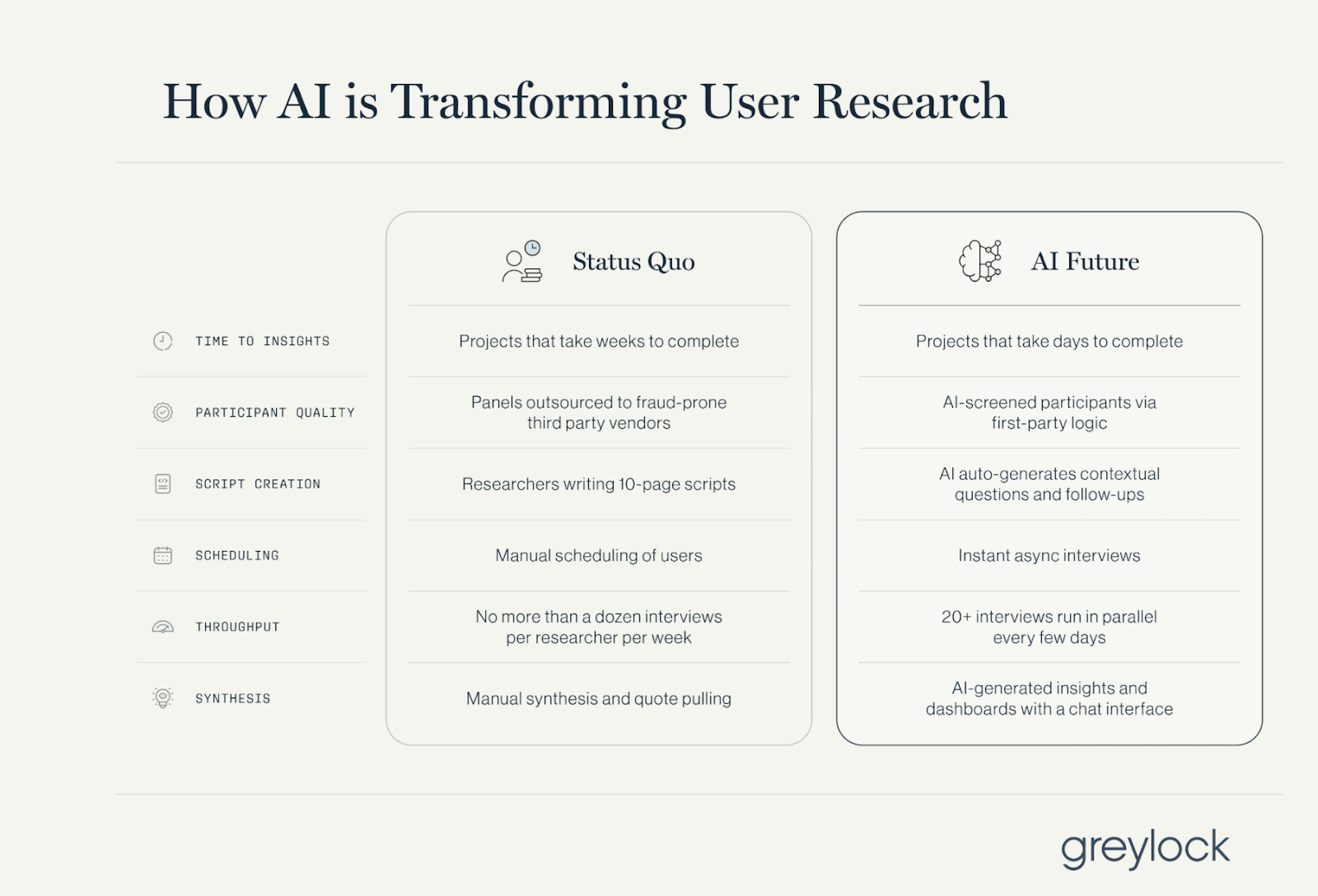
Moreover, the problem was never a lack of intent or effort, but three unrelenting bottlenecks: real-time people-dependence, time commitment, and scheduling roulettes. These also happen to (perfectly) inversely align with AI’s most promising capabilities.
Here’s an illustration from Greylock condensing this:
These aren’t just investor notes, either.
Andre Vanier, co-founder and CEO of PerceptivePanda, and a product leader with two decades of user research experience, adds a first-hand observation specific to subscription businesses: “If you are running a subscription based business, it is really hard to understand why free trials don’t convert and why existing subscribers churn, especially if you have a scaled customer base.”
AI also inverses the economics here, allowing you to run these insight-yielding interviews, but at a fraction of the cost. Now they scale.
This fit is also what prompted Andre, a three-time founder and former product executive at Yahoo, to build in this space. At PerceptivePanda, he co-founded an AI-native user interview startup with pilot customers such as Koala, Outseta, and Joy.
We met Andre at Chargebee’s annual conference Beelieve, got talking, and followed up with a longer conversation to understand what he’s seeing in the field.
In this edition of PMF /evals, we borrow from Andre’s experience to understand how AI is transforming user interviews as a vertical.
Key insights we dig into:
Why they use a deterministic layer of control on top of LLMs,
Pilot design tactics to de-risk getting deprioritized, and the traps in the Valley’s wisdom of finding 2-3 customers who love you,
Why the type of your wedge deserves as much attention as its size, and
Giving away 500 AI interviews to encourage company-wide adoption.
#1 ➤
Why they use a deterministic layer of control on top of LLMs
“If you ask a generic AI to interview someone, the result wouldn’t be just kind of ok, it would be fundamentally discordant.”
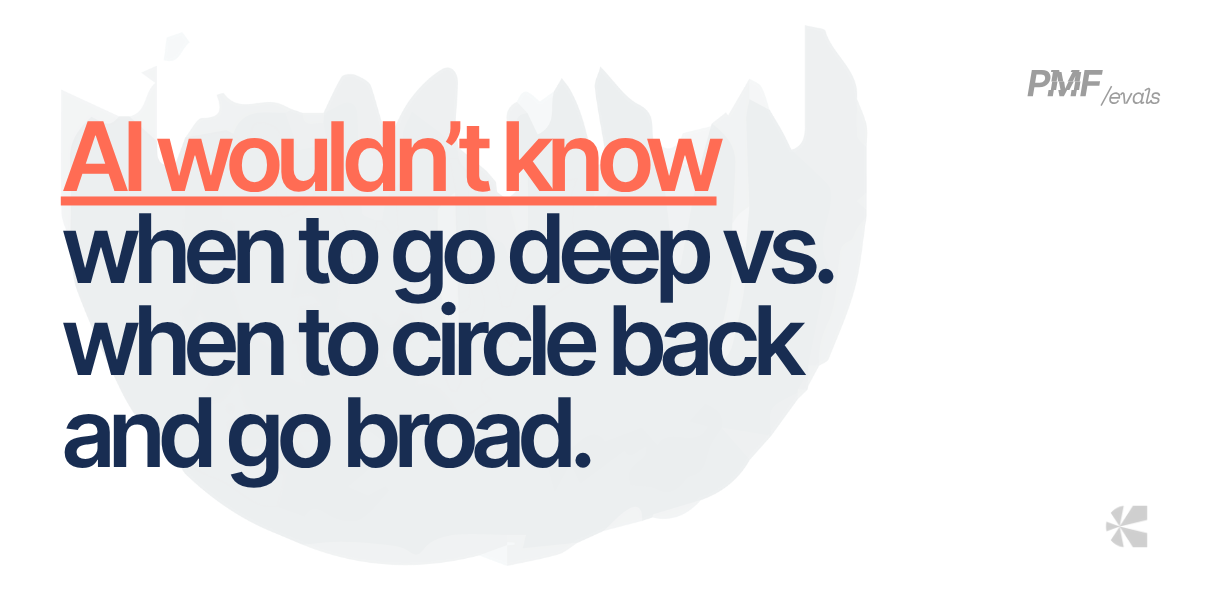
Awkward at best, and maybe even off-putting. Andre has seen that most LLMs, in their raw state, would root on one particular topic and ask 10 to 20 questions in a go. “AI wouldn’t know when to go deep vs. when to circle back and go broad.”
This is because LLMs don’t understand the unspoken conventions of human speech, they aren’t sufficiently capable for this use case by themselves.
One would wonder why not just prompt a basic LLM to “act appropriately” and add some other context. Andre says that it doesn’t work because the LLMs don’t know what these nuances of interaction mean, or what “appropriate” really looks like.
So they approached the problem from a fundamentally different angle.
Andre’s co-founder Alex Djalali, who comes with deep NLP expertise, engineered a proprietary control layer to govern the AI as it conducts interviews. This control layer modelled the state of the dialogue while using APIs to orchestrate LLMs for follow-up questions.
This has helped them leverage the fluidity and dynamic nature of an LLM while combining it with the predictability and guardrailed nature of a deterministic system. This guardrailed system is also their edge.
#2 ➤
Pilot design tactics to de-risk getting deprioritized and protect against false positives, and biases
Much like what RunLLM’s Vikram Sreekanti had shared in his interview, Andre believes that the real investment in the pre-ROI stage of a pilot is time and trust.
So they wanted to pick customers that shared their conviction about where the world is going, the weight of the problem they are trying to solve, and PerceptivePanda’s ability to solve it.
There are a few things Andre wishes he had done differently during the pilot stage.
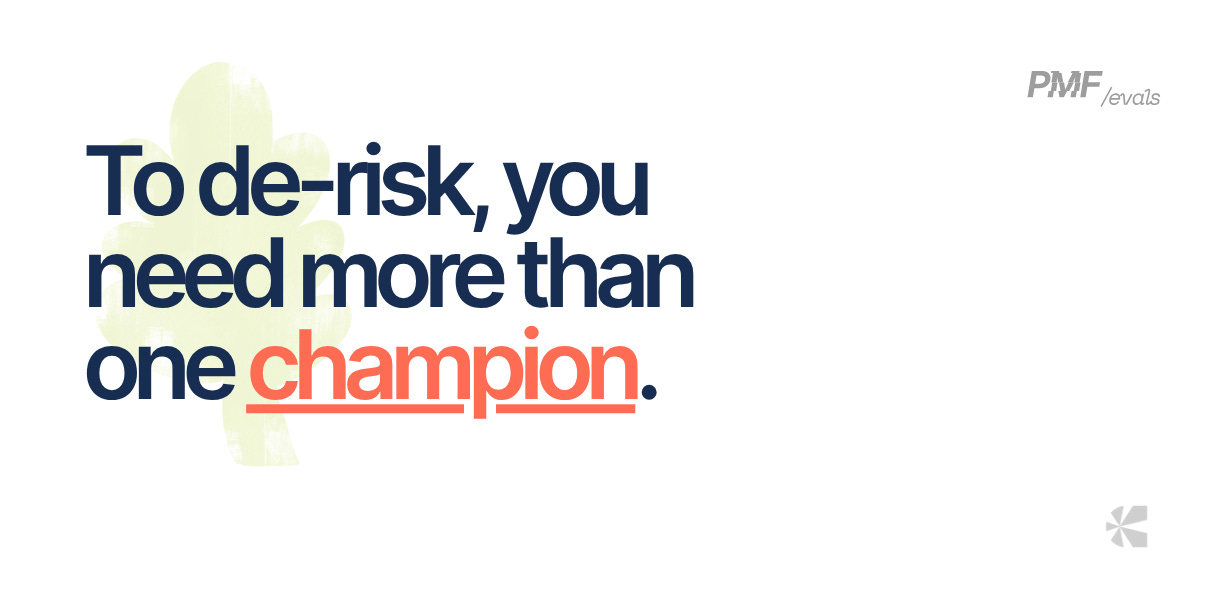
One, doing fewer pilots but networking more deeply with the leadership teams. Andre saw that B2B employment has a very high churn rate and unless you work directly with the founder or C-Suite, you run the risk of getting deprioritized or put on pause in case your champion leaves. To de-risk, you need more than one champion.
Second is a tactic that’s contrary to the popular advice of getting two or three customers to absolutely love you and then worrying about expanding. Andre saw that this can make you susceptible to biases that can prove fatal for expansion.
He realised that there are a lot of idiosyncrasies in every market and if you focus on just two to three companies, it’s possible that you end up with a solution/approach that does not generalize to other segments in the market.
He also warns against over-indexing on your network for similar reasons. In his experience, your network trusts you because they know you but the feedback you get from them might not be entirely generalizable.
What do you do in these cases?
Double or triple the number of pilots? Andre says that 3 vs. 10 is still statistically meaningless. He recommends staying aggressive with research work in parallel, instead.
What Andre did was actively explore market signals. They invested in listening to their current customers, potential customers, and even people who were unlikely to be customers, all to get a complete sense of the problem space.
These signals were: kinds of solutions these companies were evaluating, how laborious the existing processes were, and the ability of customers to quantify/articulate the benefit of moving to a better approach.
For this, he recommends supplementing your network by using userinterviews.com where you can access a large panel of folks based on industry title, functional expertise, etc. and interviewing them. This guards you against selection bias.
#3 ➤
Giving away 500 user interviews to encourage company-wide adoption
Andre and team have leaned strongly into the product-led growth ethos; they use price as a strategic lever to impact customer acquisition cost. This is based on a few convictions they have about the future.
One, they have a belief that the computational cost curve is going to continue to get forced down. While the inference costs on the deep thinking models has been rising, the LLM side of the equation has continued to get cheaper. And that’s what matters to them.
As a product that deals with real-time interactions where delays are not tolerated, the cost of deep thinking models is a non-concern for them.
On the pricing model, Andre and team have a usage-limited free plan model where the first 500 AI interviews are provided at no cost.
Their mindset here is similar to that shared by Super’s Christophe Pasquier and Wispr Flow’s Tanay Kothari — they want to prioritize habit formation and value creation over short-term cost optimization right now.
Andre is doing this by shifting their customer acquisition expenditures from ads, marketing, or other forms of distribution and putting that money back into the pocket of their customers. Not everyone can or should use this strategy, but it is a bet that they think is prudent.
Another reason for this is a focus on horizontal expansion. They aspire to ultimately enable customer 360 which is a holistic view of a customer that integrates data from a variety of touch points with a company, and not just one function.
When a team gets a generous 500 free interviews, more functions in a company can try their product and discover relevant use cases without feeling cost-constrained, this can improve pilot-to-paying conversion and retention.
Not just a hunch, they have already seen instances of horizontal expansion within orgs because of this approach.
#4 ➤
Why the type of your wedge matters as much as the size of your wedge
“Frequently as founders, we tend to think of our wedge as the small version of the bigger thing that we will eventually do and there’s certainly a lot of truth to that, but it turns out that there is a very, very rich and nuanced history of how wedges have been successfully employed.”
Every time there is a mention of a wedge, the narratives tend to heavily focus on its size. But one of the more important, often overlooked nuances is the type of the wedge.
Andre makes a h/t to the “12 Killer Wedges for Your Company’s Growth” article by NFX Ventures’s Pete Flint — a deep dive into each of the 12 basic wedge types that have been successfully used by different founders.
The wedge that Andre and team focused on is what Pete Flint calls the 10X ROI wedge. Here’s a description from the article:
“The “10X ROI wedge” works if you can instantly increase ROI or meaningfully cut costs. That’s going to give you instant traction. Many companies make this claim. Few are able to deliver. But those that do, grow fast.”
Andre and team focused on demonstrating a financially measurable benefit to customers so that they could easily stack-rank them against other priorities.
These ROI chats were based on tangible metrics such as conversion rate improvements and percentage gains in pipeline conversion.
This also points back to Andre’s focus on working with customers with conviction, as well as helping them build this conviction during the pilot phase.
P.S. A big thanks to Andre for taking the time to talk to us!
PMF /evals ◎ is just getting started. Tell us about how you’re approaching AI-native building in the wild! Or what you’d like us to cover. Hit reply.
Brought to you by Chargebee. Chargebee helps AI-native, recurring revenue businesses scale with billing and monetization infrastructure built for speed, flexibility, and rapid iteration.
Couldn't agree more. This piece is spot on. For the "inverse alignment" with scheduling rouletes, are we talking about AI actually making meeting coordination… enjoyable?